Key Takeaways
- The cost of “maintenance lag” in commercial real estate (CRE) is catastrophic; a 30-minute delay in shutting off a water main can result in six-figure water damage claims.
- Traditional answering services are too slow and often “flat-footed,” lacking the logic to differentiate true emergencies from basic tenant requests.
- Citgentic AI provides instant, intelligent triage, executing complex emergency protocols, dispatching specific on-call vendors, and notifying the management team simultaneously.
In the high-value world of commercial property management—where you oversee medical office buildings, Class A high-rises, or sprawling industrial parks—you are responsible for the physical integrity of a massive investment. Tenants are operationally dependent on your infrastructure. If a catastrophic infrastructure failure occurs after-hours, the clock starts ticking immediately. This is the moment when your emergency response system either protects the asset or opens the floodgates to massive liability.
The Cost of the Status Quo
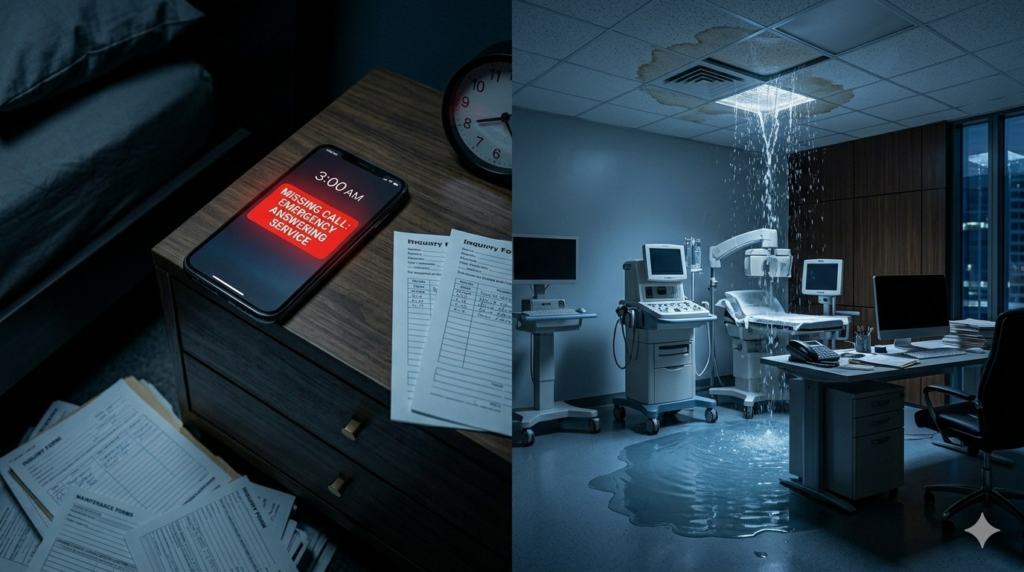
The strategic weakness for most property management firms is the reliance on passive, human-dependent answering services. These call centers are often located in different time zones and operate off generic scripts. When a panicked tenant calls at 2 AM to report a high-priority “water flow event” on the 14th floor, the answering service operator does one thing: they call the on-call property manager.
If that manager is in a deep sleep, misses the first ring, or has poor reception, the operational decay is fatal. During that 20-minute gap, that “water flow event” has cascaded through three floors of premium data center space or medical suites, destroying specialized equipment and creating catastrophic business interruption claims. The problem isn’t the vendor; the problem is the human bottleneck that delayed the triage.
How AI Automation Recaptures Revenue
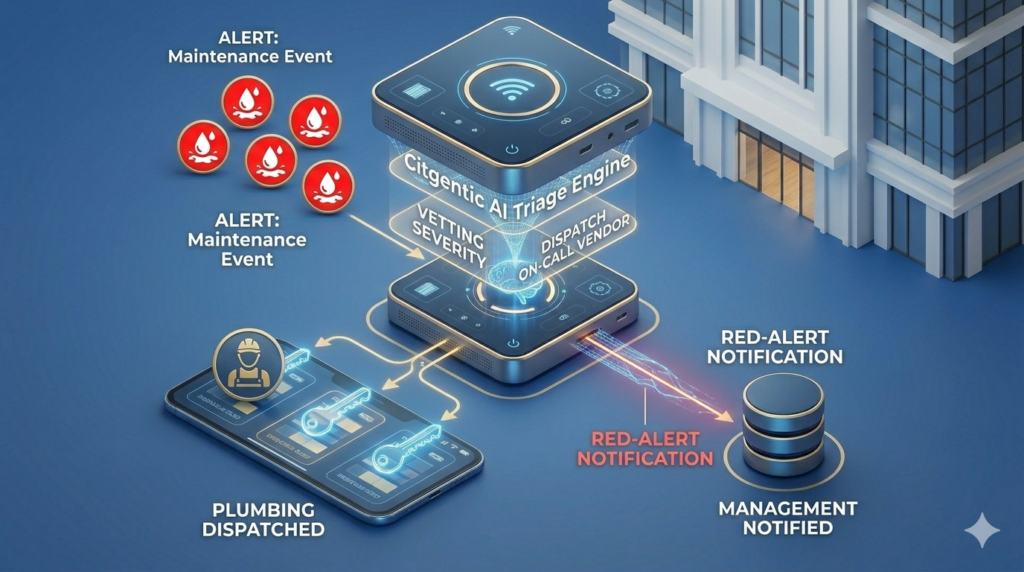
Citgentic changes the model from a reactive answering service to a proactive intelligent dispatcher. The AI functions as a digital “maintenance triage officer” that works without fatigue, 24/7.
Instant, Nuanced Emergency Vetting
Our AI voice agent doesn’t just “take a message.” It engages in immediate disaster logic. It asks the specific questions your chief engineer would ask: “Is the water clean, gray, or black?” “Are alarms sounding?” “Are electrical panels exposed?” The AI can instantly differentiate between a simple clogged toilet (a “next business day” item) and a major water main break that requires immediate vendor dispatch.
Automated Vendor-on-Call Matching
A Class A tower often has a complex tree of specialized, highly reliable vendors. When the AI confirms a major electrical failure at 3 AM, it doesn’t call the property manager; it dispatches the on-call electrical vendor. The AI possesses the knowledge base of who is on call, their contact information, and their required service level agreement (SLA). The vendor is dispatched, and the mobilization process starts before the human management team is even awakened.
Red-Alert Management Notification
The ultimate form of risk mitigation is transparency. While the AI is dispatching the vendor, it simultaneously initiates its Red-Alert protocol. It sends a specialized priority alert (via text, push, or a structured voicemail) to the entire management team, including the summary of the call, the initial triage assessment, and the time the vendor was mobilized. The management team wakes up to a fully managed response, not a panicked voicemail.
Upgrading Your Operational Infrastructure
In a competitive CRE market, technology is not a luxury; it is a critical component of risk management and tenant retention. By implementing an AI triage agent, you guarantee that every call, regardless of the hour, receives an instant, intelligent, and authoritative response. You eliminate the devastating latency of human error and replace it with operational certainty, transforming your maintenance department from a reactive cost center into a sophisticated shield that guards your asset’s value.